If you've seen headlines about microplastics turning up in food, water, and everyday products, it makes sense to wonder: what about Invisalign? Is Invisalign BPA-free? Does wearing clear aligners mean swallowing microplastics? These are fair questions, and they deserve a straight answer — not a vague reassurance. Here's what the research actually shows.
Yes — definitively. Invisalign aligners are made from SmartTrack®, a proprietary medical-grade thermoplastic material developed by Align Technology. SmartTrack is BPA-free, phthalate-free, PFAS-free, latex-free, and parabens-free, as confirmed in Align Technology's own regulatory documentation.
Consumer plastics, such as water bottles, are made to general product safety standards. Invisalign aligners are classified as medical devices, so before they ever go into a patient's mouth, they have to pass biocompatibility testing and receive FDA clearance. It's a much more rigorous bar.
If BPA was your main concern, you have your answer. Invisalign does not contain it
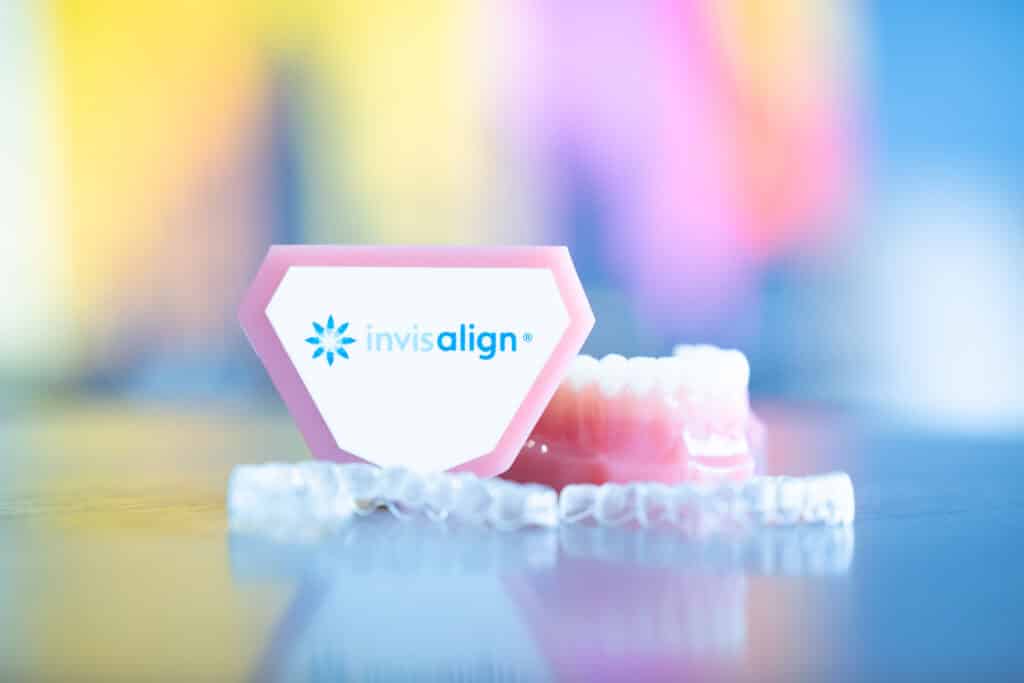
Does Invisalign cause microplastics? It's a question worth taking seriously, and the honest answer requires a little nuance.
Lab studies have found that clear aligners — including Invisalign — can release small plastic particles under simulated mechanical stress. A 2025 study published in the NIH National Library of Medicine tested Invisalign alongside two competitor aligners under conditions designed to mimic normal biting and swallowing. Invisalign performed well under those conditions, and the particles detected were smaller than 20 micrometers.
A 2025 systematic review published in NIH PubMed found no evidence of patient harm from microplastic exposure during normal aligner use. These studies examined aligners under stress in a lab setting. They're a starting point for understanding the question, and right now they don't raise any cause for concern.
It's also worth putting aligner exposure in context. Microplastics are present in drinking water, food packaging, and the air we breathe. Research from the NIH National Institute of Environmental Health Sciences confirms they are effectively ubiquitous in the modern environment. Aligner exposure does not exist in isolation — and, based on current evidence, it does not pose a meaningful risk beyond what people encounter in daily life.
The country's leading dental and orthodontic organizations agree. The American Dental Association has stated that no clinical evidence currently exists demonstrating a meaningful impact on oral or overall health from plastic particles shed by dental devices — and that its scientists are actively monitoring the research. The American Association of Orthodontists has similarly confirmed that it does not hold a formal position because the current evidence is insufficient to draw definitive conclusions, while committing to ongoing review of research. When the ADA and AAO are both closely monitoring the science, and neither is raising a clinical alarm, that context matters.
No orthodontic material is completely inert — and that's true across the board, not just for clear aligners.
Metal braces introduce steel alloys, nickel, and chromium, which can be a concern for patients with heavy metal sensitivities. Ceramic braces use alumina compounds. Bonding resins — used with both brackets and aligners — have their own polymer chemistry. A 2025 narrative review published in Progress in Orthodontics examined microplastics and nanoplastics across a broad range of orthodontic materials and found that this is a shared consideration for the field, not a problem unique to clear aligners.
All of these materials have decades of clinical use and safety research behind them. Orthodontic treatment has a long history of study, refinement, and safe use in millions of patients. Invisalign is part of that same tradition.
Taking care of your aligners properly is good aligner hygiene — not a response to fear. Here's what Dr. Petrous recommends:
Invisalign aligners are BPA-free, FDA-cleared, and held to medical device standards. Both the ADA and AAO are closely monitoring research on microplastics, and neither has raised a clinical concern. The science will keep evolving, and so will our understanding of it. In the meantime, the evidence supports Invisalign as a safe choice. If you have questions about your treatment or your child's, we are happy to talk through them at your next visit.
 Home
Home Design, video, photo, and branding by Clear Partnering Group.
